Air Quality 1.0!

Educational Quizzes

Questions

How well do you know the air you breathe? 🌬️
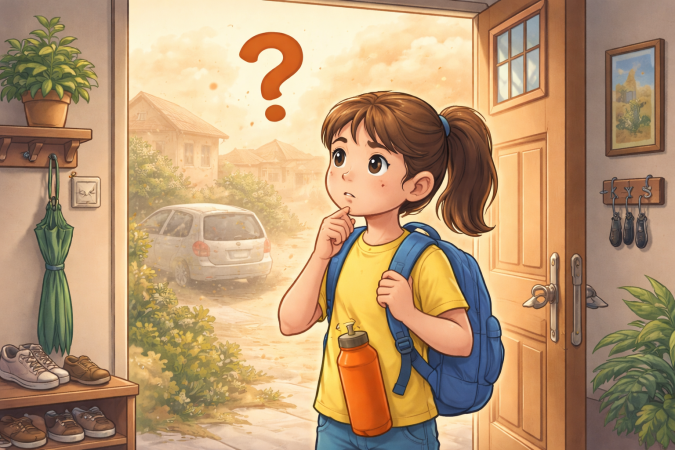
What does it mean when CO₂ rises in a classroom, and why do we feel sleepy? When is ventilation truly “smart”? Which dust is more sneaky — PM10 or PM1? And what should we do in practice when there are warnings about African dust? 😷 (hint: not air fresheners!)

When does Cyprus not have good air quality, even though it generally benefits from sea breezes?

When the sea is calm. When it is summer. When there is a lot of sunshine. When African dust is transported or when there is no wind at all.
Which activity often increases particles (particulate matter) indoors?
Flicking the pages of old books. Frying/grilling without ventilation. Intense exercise. Loud music!
Your answer is incorrect!
TRY AGAIN
Correct!
Cyprus often has good air quality — but not always. Phenomena such as African dust, exhaust fumes, and calm (windless) conditions can temporarily worsen it.
Good air quality is not permanent. Even in places with favorable conditions, natural phenomena and calm air can increase particle levels.
We don’t control the weather — we control our behaviour. Information → adaptation → better air quality.
Many irritants are invisible — we don’t always detect them by smell.
High CO₂ = little fresh air. It’s a signal to ventilate.
Many people + closed windows = rapid CO₂ increase.
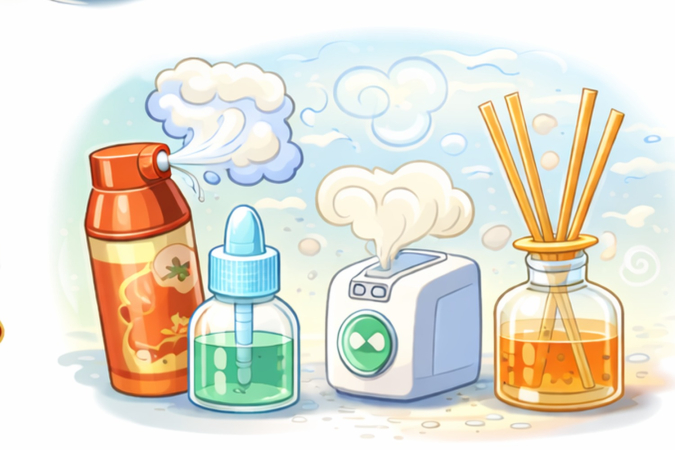
Fragrance masks odors — it does not clean the air.
Good ventilation = short and well-timed.

Cooking is a common Particulate Matter (PM) source. A ventilation hood or window is needed.

Smoke “sticks” to surfaces which we often touch afterwards — it’s not just about smell.

Many VOCs (Volatile Organic Compounds) irritate the eyes, nose, and throat indoors.

Source → reduction → ventilation. Almost always works.

What is visible warns us. What is invisible (very small particles) stays longer in the air and enters deeper into the lungs.
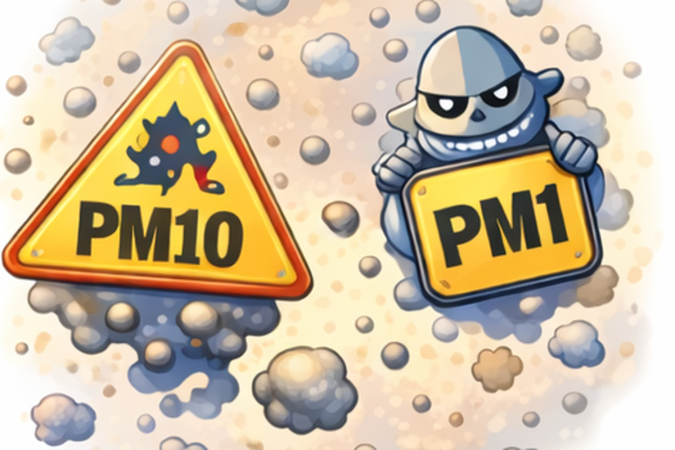
PM10 is “coarser” dust and is often visible. 👉 The smaller the particle, the longer it stays airborne and the deeper it can enter our body.
The smaller the particle, the more easily it “travels” inside us.
“Coarse” dust (PM10) is often visible and falls faster. Very small particles (PM1) are invisible, remain airborne much longer, and are not easily blocked by the body.

They bypass the body’s natural “filters” and, without us realizing it, enter deep into the lungs (alveoli), where they can affect breathing and health.

The alveoli are the most sensitive part of breathing — this is where oxygen passes into the blood. Anything that reaches there is not easily removed and, with repeated exposure, can affect the entire body.
A KN95 / FFP2 mask provides good protection only if it fits properly, because it is designed for particles, not just droplets. 👉 If possible, the best option is to reduce the time spent outdoors.
NEXT QUESTION
Your answer is incorrect!
Correct!
A KN95 / FFP2 mask provides good protection only if it fits properly, because it is designed for particles, not just droplets. 👉 If possible, the best option is to reduce the time spent outdoors.
TRY AGAIN Close Quiz