Shoes and nature!

Educational Quizzes

Questions

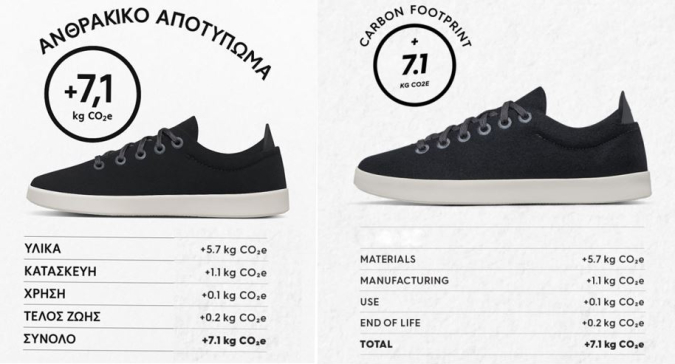
Have you ever thought how much our shoes 'cost' to the environment?

According to the image, which stage produces the largest share of emissions?
Materials Use End of Life Manufacturing
How much CO₂e comes from manufacturing the shoe?
0.2 kg 5.7 kg 1.1 kg 0.1 kg
Which stage of the shoe’s life cycle contributes the least CO₂e?
Use Materials Manufacturing End of Life
Why do companies include a carbon-footprint label on their shoes?
To show the price To show the environmental impact To display shoe size To advertise shoe colour
If producing this shoe releases 7.1 kg CO₂e, this is roughly equal to how much driving in Cyprus?
About 5 km (Nicosia → Mall) About 45–50 km (Nicosia → Larnaca) About 150 km (Nicosia → Paphos) About 20 km (Larnaca → Zygi)
A typical car emits about 0.15 kg of CO₂ per kilometre. If the car makes a 190 km trip (going and returning from Protaras to Nicosia), how many “shoe footprints” (7.1 kg CO₂e each) does this trip equal?
About the same as buying one pair of shoes About the same as buying a pair of shoes for 2 students About the same as buying a pair of shoes for 4 students More than buying shoes for the whole classroom (20 students)
Your answer is incorrect!
TRY AGAIN
Correct!

Every product has a hidden “invisible cloud” of greenhouse gas emissions created before you even buy it.

Think of boiling water: you don’t put steam into the pot — it forms because of energy used. Similarly, making a shoe requires electricity, heat, materials and transport — all release CO₂ even if none remains in the shoe.
Different gases warm the planet differently — CO₂e is a common “currency” to compare them fairly.
CO₂ is essential — plants “eat” it to make oxygen. The problem is that humans add more CO₂ than nature can absorb, creating a thicker heat-trapping blanket around Earth.
Raw materials often require extraction, farming, chemistry, heat and long supply chains — this usually dominates emissions.
Manufacturing = the energy used by machines, factories and workers to turn materials into the shoe you see.
Shoes don’t burn fuel when you wear them — they’re powered by your legs, not electricity or petrol.
End of Life = recycling, shredding, burning or landfill — all release some carbon. As you outgrow your shoes, perhaps you can give them to someone before ‘ending their life’!
The world is moving toward transparency — companies now show the “true cost” to the planet, not just the financial one.
Always read the table carefully: materials are usually the biggest contributor for clothing and shoes.
A typical car emits ~0.15 kg CO₂/km. Divide 7.1 by 0.15 to estimate the distance.
A 190 km trip produces: 190 km × 0.15 kg = 28.5 kg CO₂, which is equal to about the emissions for making 4 pairs of shoes (28.5 ÷ 7.1 ≈ 4). Isn’t it amazing how much CO₂ is emitted by a single “innocent” trip to the sea? It makes such a big difference filling the car, sharing the ride, or taking the bus. Car-sharing can reduce each person’s emissions dramatically — sometimes even more than choosing low-footprint products!
NEXT QUESTION
Your answer is incorrect!
Correct!
A 190 km trip produces: 190 km × 0.15 kg = 28.5 kg CO₂, which is equal to about the emissions for making 4 pairs of shoes (28.5 ÷ 7.1 ≈ 4). Isn’t it amazing how much CO₂ is emitted by a single “innocent” trip to the sea? It makes such a big difference filling the car, sharing the ride, or taking the bus. Car-sharing can reduce each person’s emissions dramatically — sometimes even more than choosing low-footprint products!
TRY AGAIN Close Quiz